PLY-Syllabus
Plyometrics for Agility & Power
Duration: 24 hours
Online learning: 04 sessions of 90 minutes each – 6 hours.
Practical training: One day comprising 8 instructional hours, with breaks scheduled separately.
Home study: 10 hours
The practical day combines physical participation, demonstrations, observation, coaching practice and assessment. Exercise exposure is managed to maintain movement quality and appropriate recovery.
PART I: ONLINE THEORY — 6 HOURS
Session 1: Foundations and Physiology of Plyometrics
Duration: 90 minutes
1. Meaning, objectives and relevance
Definition and characteristics of plyometric exercise.
Distinguishing maximal strength, explosive strength, power and reactive strength.
Applications in fitness, athletic development and sports conditioning.
Historical development, including Dr Yuri Verkhoshansky’s pioneering Shock Method.
2. Physiological foundations
The stretch-shortening cycle.
Eccentric loading, the amortisation phase and concentric propulsion.
Elastic energy storage and release in the muscle–tendon system.
Stretch reflexes, neuromuscular coordination and rapid force production.
Differences between fast and slow stretch-shortening actions.
Fatigue, recovery and their effects on exercise quality.
3. Training adaptations
Potential improvements in jumping, acceleration and reactive performance.
Complementary roles of resistance training and plyometrics.
Specificity and limitations of transfer to sporting performance.
Session 2: Movement Mechanics, Readiness and Progression
Duration: 90 minutes
1. Mechanics of jumping and landing
Posture, alignment and coordinated ankle, knee and hip action.
Countermovement, arm swing and take-off.
Force absorption, balance and landing control.
Vertical, horizontal and lateral force production.
Bilateral and unilateral movement demands.
2. Readiness assessment
Training history, previous injuries and current symptoms.
Relevant strength, mobility, balance and movement competency.
Observation of squatting, landing and single-leg control.
Identifying when to modify activity or seek professional referral.
3. Progression principles
Submaximal drills before demanding reactive exercises.
Progression through amplitude, speed, direction and complexity.
Controlled landings before repeated rebounds.
Criteria for advancing, regressing or stopping a drill.
4. Inverted Funnel Principle and Frappier footwork
Relationship between centre of mass, foot placement and stability.
Maintaining trunk control while the feet move rapidly in different directions.
Introduction to Frappier-style line and quadrant patterns.
Distinguishing preparatory footwork from higher-intensity plyometric loading.
Session 3: Exercise Classification and Coaching Methods
Duration: 90 minutes
1. Lower-body exercise categories
Submaximal rhythmic drills and low-amplitude rebounds.
Jumps in place.
Standing vertical and horizontal jumps.
Multiple jumps and hops.
Unilateral and alternating hops.
Bounding.
Box jumps and related box drills.
Drop landings, drop jumps and depth jumps: purposes and distinctions.
2. Preparatory movement skills
Lunging and multidirectional stepping.
Backward running, lateral shuffling and carioca.
Braking, repositioning and reacceleration.
Recognising that these movements are not automatically plyometric exercises.
3. Upper-body plyometrics
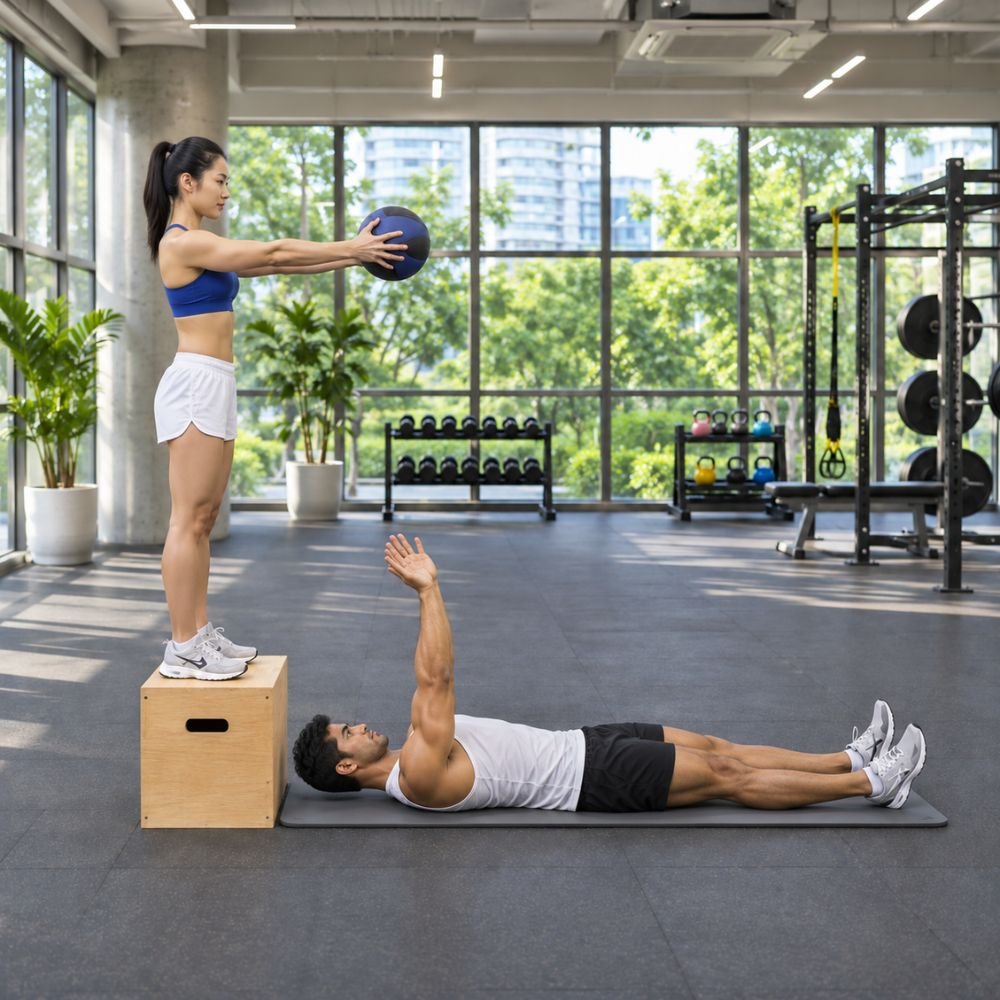
Medicine ball chest passes, overhead throws and rotational throws.
Appropriate rebound and partner drills.
Explosive pushing progressions.
4. Coaching practice
Demonstration, observation and concise cueing.
Common errors and corrective strategies.
Individual and group organisation.
Managing spacing, equipment and partner responsibilities.
Session 4: Programme Development and Applications
Duration: 90 minutes
1. Needs analysis
Trainee goals, training age and physical readiness.
Sport, playing position and movement demands.
Selecting realistic and measurable outcomes.
2. Exercise prescription
Exercise selection and order.
Intensity, sets, repetitions and total contacts or throws.
Frequency and recovery between repetitions, sets and sessions.
Movement direction, unilateral loading and external resistance.
Monitoring fatigue and maintaining technical quality.
3. Integrated training
Combining plyometrics with resistance, sprint and agility training.
Complex training: pairing appropriate resistance and explosive exercises.
Balancing potentiation, fatigue and individual responses.
Progression across a training block and competitive season.
4. Goal-specific and sport-specific applications
Vertical jumping, horizontal propulsion and acceleration.
Braking and change-of-direction preparation.
Throwing and upper-body power.
Adapting programmes for beginners, developing athletes and experienced trainees.
5. Monitoring and evaluation
Standardised jump and hop measurements.
Technique observation and simple video analysis.
Recording workload, symptoms and performance.
Using results to revise the programme.
PART II: PRACTICAL TRAINING — 8 HOURS
| Practical Module | Duration | Activity |
| 1. Preparation and readiness assessment | 60 min | Equipment and surface checks; dynamic warm-up; movement screening; baseline jump measurements; landing and balance observations. |
| 2. Landing mechanics and foundational drills | 75 mins | Athletic stance; controlled force absorption; snap-downs; jump-and-stick exercises; low-amplitude rebounds; bilateral-to-unilateral progressions; coaching corrections. |
| 3. Footwork and multidirectional preparation | 60 mins | Frappier-style line and quadrant drills; Inverted Funnel Principle; lunging, backward running, lateral shuffling and carioca; planned braking and repositioning. |
| 4. Jumping, hopping, bounding and box drills | 90 mins | Jumps in place; standing jumps; repeated jumps; hops and bounds; box-jump technique; stepping down; drop landings; demonstration of advanced reactive drills and eligibility criteria. |
| 5. Upper-body plyometrics | 45 mins | Medicine ball passes and throws; rotational actions; explosive pushing progressions; partner positioning, catching and equipment control. |
| 6. Integrated and sport-specific applications | 60 mins | Resistance–plyometric pairings; links with acceleration and change-of-direction skills; adapting drills to selected sports and performance goals. |
| 7. Programme design and assessment | 90 mins | Small-group programme development; participant-led coaching; exercise demonstration; peer feedback; individual practical assessment and programme review. |
| TOTAL | 480 mins | 8 instructional hours |
CAUTION:
Advanced drill participation: Depth jumps and other demanding reactive exercises are demonstrated selectively. Physical participation depends on readiness and technical competence; observation and coaching analysis provide alternative learning activities.
Contraindications: Plyometrics must be adjusted according to age, medical condition/s and fitness goals.